

How Knitting Connects Us
June Fiber Book Club :)

Apologies for the Fiber Book Club delay! These will now come out the last Thursday of every month. Next will be July 30 and include essays On Knitting through Knit Your Bit (pages 163-195). For those who are new here, we are working our way collectively through the book Knitting Pearls: Writers Writing About Knitting in small chunks. Join us!
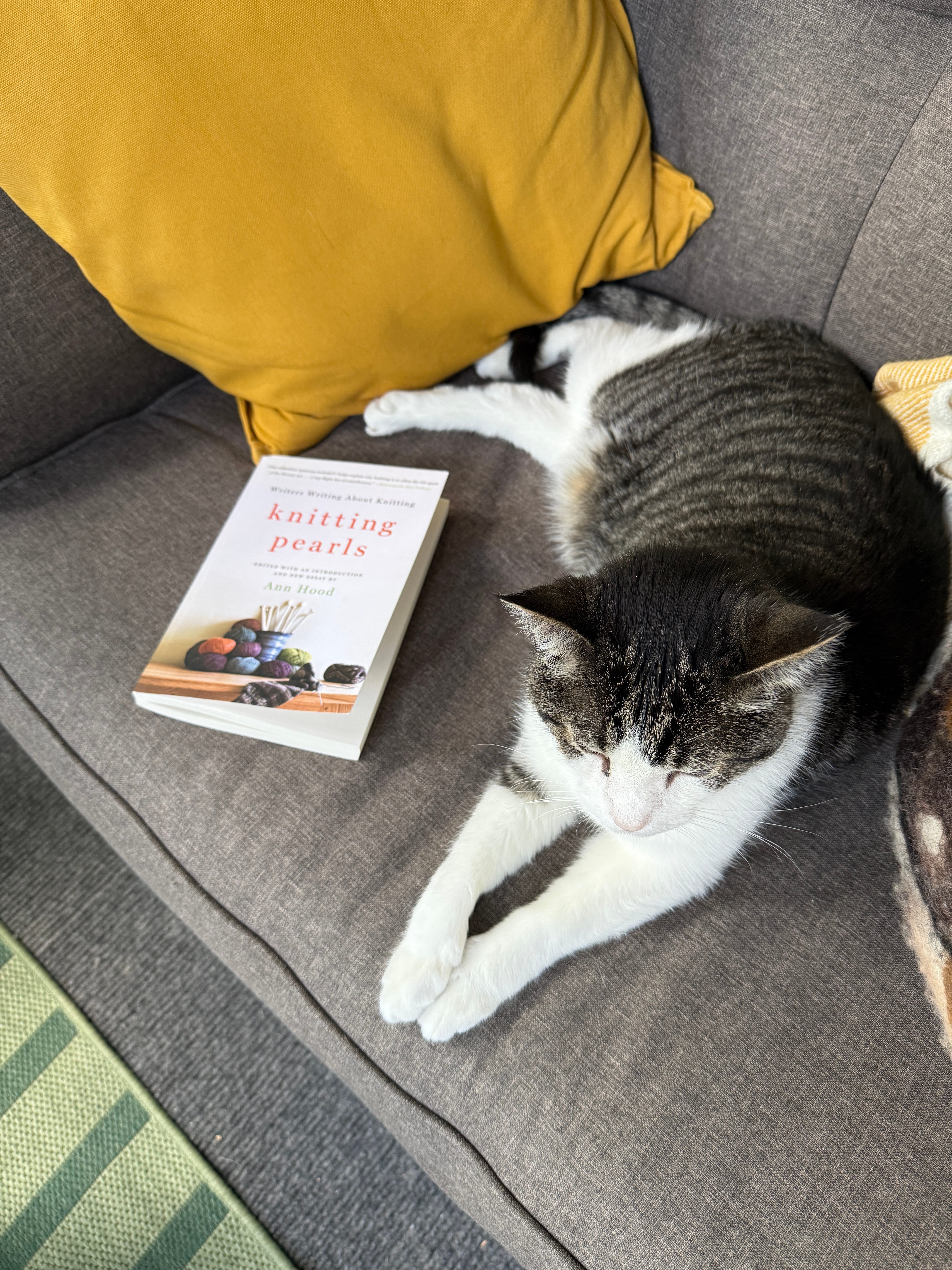
For a long time, there was so much I didn’t understand about knitting. Kate and I think about this a lot when we plan our knitting classes: knitting is not a craft you can just drop into. It’s not an activity that you can spend a single session doing and get something beautiful or even useful out of it (I’ll give you the cotton dish cloth, I guess). I learned to knit in third grade in an afterschool program and I made a hat. I don’t even know how 8 year old me managed to decrease in a perfect dome shape - probably a fair amount of the teaching ladies grabbing the needles from my small hands and just doing it.
So when the inkling to knit came back to me as a teenager, I decided to go to a real yarn store and see what was going on. That store was Knit Purl in downtown Portland, Oregon. One of my favorite pastimes after school was to take the bus downtown and go to Pioneer Place mall to shop or get frozen yogurt. But that day I tried something new. I walked into this small corner shop with minimal inventory and saw small stacks of hanks in gorgeous tones. I don’t think I’d ever seen a hank before. I remember picking one up, in a deep and very natural emerald green, and looking at the price tag. I had only ever worked with cheap yarn, and I don’t remember ever purchasing it myself. So, in 2010, staring down at a $30 price tag for one hank of yarn? On a teen’s budget of money earned teaching summer swim lessons? Terrifying. I remember feeling like I could not stay and walking right back out the door.
Knit Purl closed in 2018, and this memory came back to me because they contributed a pattern to this book, Knitting Pearls. I wish I could go back now and appreciate the artistry they were surely doing. But learning to knit also comes with learning a culture and an industry. One of the main questions our students ask when they are beginners is, ‘how do I know what yarn to choose?’ The variety of options of not only the yarn (fiber content, weight, color) but also the tools (straight needles, circular, double points) is overwhelming. And forget about learning to read a pattern! These skills need to be collected over time. If you’re lucky enough to have good teachers, friends or mentors to guide you, it becomes easier to see the big picture.
The main takeaway I keep coming back to as I’m reading through Knitting Pearls is the myriad of ways that knitting connects us. Lily King writes in her essay, The Italian Hat, how “handwork” was one of her daughter’s classes at an Italian private school. It was a class she could excel in because she didn’t need to know how to speak or understand Italian to succeed. Jane Hamilton writes about living with a Harris Tweed weaver in Scotland (What Happened in Scotland) and how in the evenings she wasn’t allowed to read but she could knit as they sat by the fire. She feared her host might not have had the skills to read full novels, but knitting was common ground for their nightly pastimes. And two writers explore how they did not knit, one connecting with her mother-in-law (My Mother-In-Law, Her Knitting, and Me) and finding a place in a new family, and one unable to succumb to this “women’s work” when she could be writing (How We Spend Our Days).
I was especially touched by Perri Klass’s essay, The Museum of the Lady with Only One Neck, as she cleans out her late mother’s apartment and finds all the pieces she knit for her over the years. Each garment holds such a specific memory. I think that is the power in craft. We make something with our hands, we learn, we redo, we modify and we find a worthy home for that object. The style, the color, the fiber, remind us of the maker and act like a time capsule of the time it was made. Was the yarn fancy and expensive? Was it the color trend of that year? Does the recipient wear it because they love it or because they love the hands that made it?
I’ve really been enjoying reading these essays, as a knitter and as a writer. Thanks for reading along with me. Did you have a favorite essay this month?
My favorite passage I noted was this, “Annie Dillard once wrote, “How we spend our days is, of course, how we spend our lives.” This line has been a touchstone and a rallying cry for me as I’ve struggled to find time to write fiction while raising three boys, teaching, and working as a freelance editor. Ms. Dillard’s words remind me that it is easy to let days go by without writing, but in doing so I am making a statement about what I value, what matters most to me.” - Christina Baker Kline
Here’s to finding time to do the things we love!
Happy knitting,
Laila